
Nutrition: 5 small dietary adjustments for BIG behavioral changes in your horse.

Updated: Dec 2, 2025
The power of nutrition: Why "Back to Basics"?
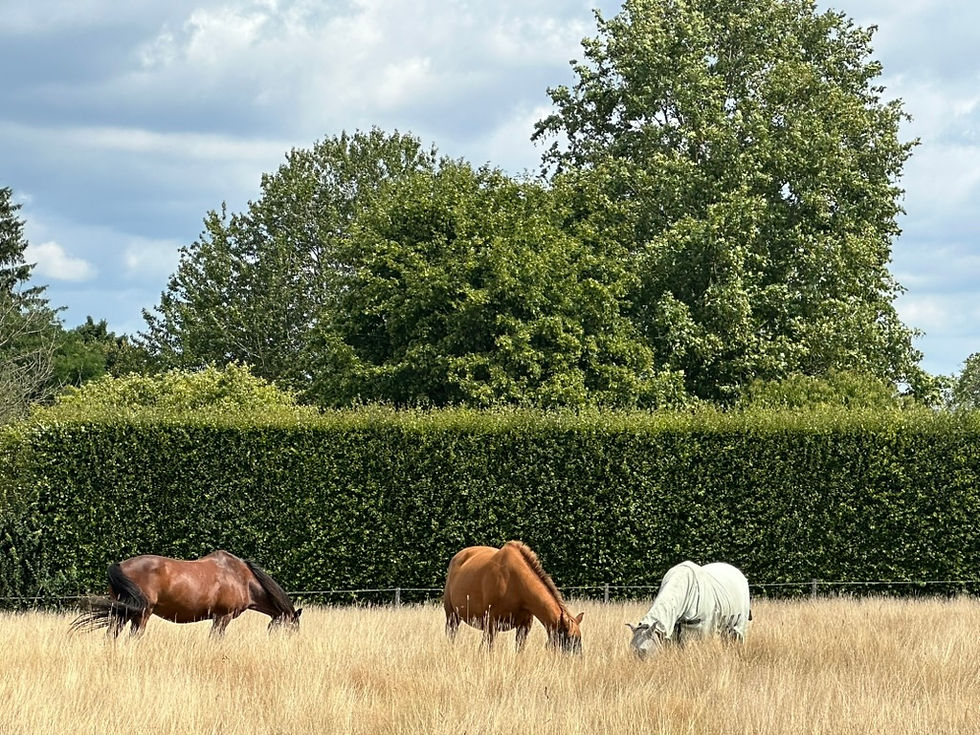
We often spend a lot of time, money, and energy on complex training techniques or expensive, specialized supplements in the hope of improving our horse's behavior. Many seek the solution in the latest methods, but miss the point that fundamental peace and balance begins at the very beginning.
Over the years, I've worked with countless horses and owners, and I've seen one crucial mistake repeated time and again: we feed horses like humans, instead of the grazers they are by nature. A horse has a digestive system designed to process small amounts of roughage almost continuously. As soon as we deviate from that natural rhythm—through long fasts, too much sugar, or too little structure—we unknowingly create stress, anxiety, and even unwanted behavior.
My own horse showed me years ago how profound the impact of nutrition can be. A small adjustment to his roughage management and the elimination of certain fasting sugars resulted within a few weeks in a horse that was not only calmer, but also demonstrably happier and more cooperative under saddle.
My mission is to share this knowledge: you don't have to make radical changes. By focusing on mimicking natural feeding behavior and making a few small, targeted adjustments to the feeding regimen, you can achieve significant behavioral improvements and improved mental well-being in your horse.
Below I share the 5 small dietary adjustments that can bring about a BIG and lasting behavioral change in your horse.
Tip #1 - The 😳 truth: Your horse isn't being annoying, he might just be hungry?!?!
Do you sometimes wonder? How long does my horse really go without roughage, especially at night?
The most crucial adjustment to improve your horse's well-being is eliminating long fasting periods.
The stomach produces acid continuously. When a horse goes without food for more than four hours , its stomach is empty, meaning the stomach acid can damage the stomach lining and cause stomach ulcers.
Stomach ulcers are a huge source of stress, pain, and restless behavior. This often manifests as restlessness, annoying behavior, or even stable vices .
The bottom line is: what you see as 'annoying' behavior is often an expression of physical discomfort due to hunger and stomach acid.
❗️ So make sure your horse never goes without roughage for more than four hours . Providing roughage for as long as possible helps the horse stay mentally relaxed .
‼️ Offer roughage as freely as possible, or use a slow feeder to minimize periods without roughage, especially at night.
Tip #2 - Chewing Time: The stress-reducing power of saliva
Did you know that horses are designed to chew 16 to 18 hours a day?
This immense need to chew has a direct and vital effect on their mental and physical health . If horses eat too quickly (for example, a portion of concentrated feed in a few minutes), they miss out on this natural relaxation and protection.
"Digestion begins in the mouth." Chewing well and long enough is the key to success.
The key lies in saliva production. Unlike humans, horses only produce saliva when they chew. Saliva is vital because it contains a natural buffer that continuously neutralizes the aggressive stomach acid before it can damage the stomach lining.
❗️Result: A horse with sufficient chewing time and a neutral stomach is inherently a calmer horse . You reduce the risk of stomach ulcers, which often lead to restlessness, nipping, biting, bucking, and girth anxiety during work.
‼ ️Longer chewing time → More saliva → Neutral stomach → Less stressful behavior .
Tip #3 - Calm the system: Swap fast sugars for sustainable energy
Do you ever stop to think about what fast sugars and starches actually are?
Fast Sugars and Starches are carbohydrates that are digested and absorbed very quickly by the horse's stomach and small intestine, resulting in a sudden rise in blood sugar (the "spike"). They are found in high concentrations in the grain .
Many traditional concentrates are loaded with these concentrated sugars and starches. In nature, a horse would only consume the grain as part of a whole grain plant . The grain is then surrounded by many stems and leaves (fiber), which ensures slow digestion and absorption. In commercial feed, the horse receives the concentrated grain without this natural fiber buffer.
The primary reason for limiting grains is the way they are processed in the horse's body:
Sugar spikes: Large amounts of concentrated starch are quickly broken down into sugars. This causes a blood glucose spike , which manifests as explosive energy, nervous behavior, skittishness, and a hot streak under saddle.
Intestinal acidification: Excess starch that the small intestine can't process flows into the large intestine. Here, it disrupts healthy gut flora, which can lead to gas, risk of colic, and intestinal acidosis . An uncomfortable, acidic gut inevitably leads to a horse that feels unwell and is more reactive.
The solution is simple: replace grain-based concentrates with fiber-rich alternatives.

❗️ Replace grains and choose concentrated foods that get their energy from fiber and healthy fats.
‼️ Feed sufficient roughage and provide plenty of fresh drinking water.
This leads us seamlessly to the next tip.
Tip #4 - Small portions of concentrated feed: Stability in energy
Did you know that a horse's stomach is relatively small?
With a capacity of only 8 to 15 liters, a large horse's stomach is surprisingly small for its size. This is the ultimate proof that the horse is a non-stop grazer and absolutely not designed to process a large amount of energy-rich feed at once.
Large portions of concentrated feed (rich in the fast sugars and starches from Tip #3) are a double burden on the system because of that small stomach:
Overload: The stomach cannot handle the large amount at once, which increases the risk of digestive problems, acidity and stomach ulcers.
Rollercoaster: Large meals cause rapid energy dips and spikes in the blood, the so-called "rollercoaster." This leads to a horse that is hyperactive shortly after feeding, but can become lethargic and unfocused again shortly afterward.
By distributing the concentrates, you keep the blood sugar level more stable and therefore also the mood of your horse.
❗️ Feed in smaller portions.
‼️ Feed several times a day, preferably 3 to 4 times.
This reduces peaks and dips, but will mainly ensure that your horse receives small amounts of the necessary nutrients throughout the day and therefore never goes without for a few hours.
"Feeding several small portions of food per day ensures a more stable blood sugar level." - Natascha Bos - Blauwe Hengst
💡 If you want to know more, this is recommended: https://blauwehengst.nl/themadag-natuurlijke-voeding/ (in Dutch)
Tip #5 - Behavior change is more than just the food bowl.
This last tip encapsulates the true conclusion: nutrition never stands alone. The way you feed is inextricably linked to the way your horse lives. The ultimate goal of these 5 tips is to mimic a grazer's natural habitat .
We've seen that the digestive system is designed for non-stop exercise and non-stop eating. Even the perfect pellets in the perfect amount won't help if the horse is stationary for the rest of the day.
Exercise + Food: Natural grazers spend all day searching for food. By distributing the feed (such as multiple hay nets in different locations, or using a tracking system), you combine feeding (Tip #1 & #2) with exercise. This stimulates their gut and provides mental stimulation.
Social + Nutrition: Horses naturally eat in groups. Loneliness or stress in the herd can negatively impact digestion and behavior, no matter how good the feed is.
So also optimize the environment.
The greatest behavioral change is achieved by integrating the nutritional tips into the housing:
Enrich the Environment: Provide as much free movement and social interaction as possible 24/7.
Spread the Hay: Prevent the horse from having to stand in one spot for hours waiting for the next feeding (Tip #1). By spreading the roughage sources (with slow feeders, Tip #2), you utilize all 5 tips simultaneously and create the most natural, stress-free environment for the horse.
Finally: The power of the foundation
As you can see, the steps to a calmer and happier horse aren't expensive or complex training techniques, but a return to the basics of horse physiology and natural needs. From ensuring constant forage availability to eliminating fast sugars, and ultimately, creating an environment that supports these principles.
Small, conscious dietary adjustments, combined with a natural attitude, are the key to BIG and lasting behavioral changes .

Do you have any questions? Contact us!
Join the conversation!
Thank you for reading our latest blog post! We strive to create content that is truly valuable to our readers.
Want to be the first to know? Subscribe to our blog! You'll receive all new content directly in your inbox and never miss an update.
What topic would YOU like to know more about?
Let us know in the comments.
YOUR suggestions help us write an even more relevant blog next time.
GOOD LUCK !
Ann


Comments